
The short version
The gates got good. Each extra "nine" of two-qubit fidelity has taken eight to ten years. A whole machine passed 99.9% in 2024, and one pair of ions reached 99.99% in 2025.
Error correction now works at small scale. Bigger codes have beaten smaller ones since 2023, and by a wide margin since December 2024. In September 2026 an error-corrected two-qubit gate beat the bare gate it is built from.
Factoring is stuck at 15. The number 21 needs 115 times more gates. Nobody has run that circuit, and every published "21" skipped the hard part.
Gil Kalai's 2019 predictions are being overtaken, and he has not conceded. He said small error-correcting codes would fail and gate quality would stall. In 2026 he says the codes are "not strong enough so far to refute my theory".
The dates moved in. Scott Aaronson calls an error-corrected run of Shor's algorithm before November 2028 "a live possibility". Company roadmaps and DARPA point at 2029 to 2033. Dated promises of usefulness have mostly been missed before.
1 · Factoring 21
21 is 115 times harder than 15
In 2001 a quantum computer factored 15 with a circuit of 21 entangling gates: operations on two qubits at once, where most errors happen. The number 15 is a lucky case: most of the multiplications in Shor's algorithm turn into nothing, or into swapping two wires. The number 21 has no such luck. In August 2025 Craig Gidney of Google wrote out the cheapest circuit he could find for it: 191 two-qubit CNOT gates and 369 three-qubit Toffoli gates on 15 qubits. Counting each Toffoli as six, that is 2,405 entangling gates.
One dot per gate: drag the fidelity to see how many fail
Red dots are gates that failed in one typical run. A run with no red dot gives a clean answer.
This page's arithmetic: the chance of a clean run is the fidelity raised to the number of gates. It counts two-qubit gate errors only and treats them as independent. Idle time, measurement and single-qubit errors make it worse; a noisy run can still sometimes give the right answer.
How far away is it?
- On bare gates, close. At 99.92% about one run in seven would pass all 2,405 gates clean. A trapped-ion machine could try that today, and nobody has published it. Gidney's own guess is that a realistic circuit costs 500 times the circuit for 15, about 10,000 gates. That needs 99.99% across a whole machine, which so far exists on one pair of ions.
- With error correction, further. The circuit needs 369 Toffoli gates, the expensive kind, each worth four to seven "T" gates. The largest run on encoded qubits found for this page used 468 T gates on 70 logical qubits (IBM and the University of Chicago, July 2026 preprint), with an encoding the release says detects errors. Gidney expects error correction to be the route, and puts the whole job at "ten thousand times more expensive" than factoring 15.
- Nobody is racing to do it. Gidney: "factoring isn't yet a good benchmark for tracking the progress of quantum computers." He says to watch whether error-corrected qubits get more reliable as they grow. Aaronson compares asking for 35 now to asking the Manhattan Project in 1943 for "at least a small nuclear explosion".
Why 15 is so cheap: three lucky breaks
Shor's algorithm multiplies a register by a list of constants, each multiplication switched on or off by a control qubit. That is the whole cost. Gidney counts three ways the number 15 escapes it.
- Most multiplications are by 1. For 15 the list of constants is 2, 4, 1, 1, 1, 1, 1, 1, so only two of eight do anything. For 21 it is 2, 4, 16, 4, 16, 4, 16, 4, 16, 4. That costs about 4 times more.
- The first multiplication is nearly free. The register starts at 1, so the first step only copies a known number in. That halves the work for 15 and saves a tenth for 21: about 1.8 times more.
- Multiplying by 4 is a swap. Because 15 is one less than 16, multiplying by 2 or 4 modulo 15 only rotates the bits: two controlled swaps. Modulo 21 the best circuit found by computer search uses 41 Toffoli gates. That costs about 20 times more.
Gidney calls his circuit for 21 more optimised than is realistic: "a more plausible amount of optimization would produce a circuit with 500x the cost of the factoring-15 circuit".
Counted for this page from his circuit file: 15 qubits, 191 CNOT, 369 Toffoli, 10 measurements. A Toffoli counts as six two-qubit gates.
The papers that said they factored 21, and the dog
Photonic and superconducting experiments in 2012, 2019 and 2021 reported factoring 21. Each ran a "compiled" circuit, simplified using facts that only someone who already knows the factors has. Gidney: "they don't do the multiplications, because the multiplications are hard … So I don't count them."
- Smolin, Smith and Vargo (Nature, 2013) showed that with such shortcuts two qubits can "factor" any product of two primes. The right measure, they wrote, is the length of the period found, not the size of the number.
- Annealing and variational "records" (143, 56,153 and larger) pick numbers whose factors differ in a few bits. A 2022 preprint claimed a path to RSA-2048 with 372 qubits; a check found the method stops working near 70 bits. A 2024 story that a D-Wave machine had "broken RSA" was about a 22-bit number.
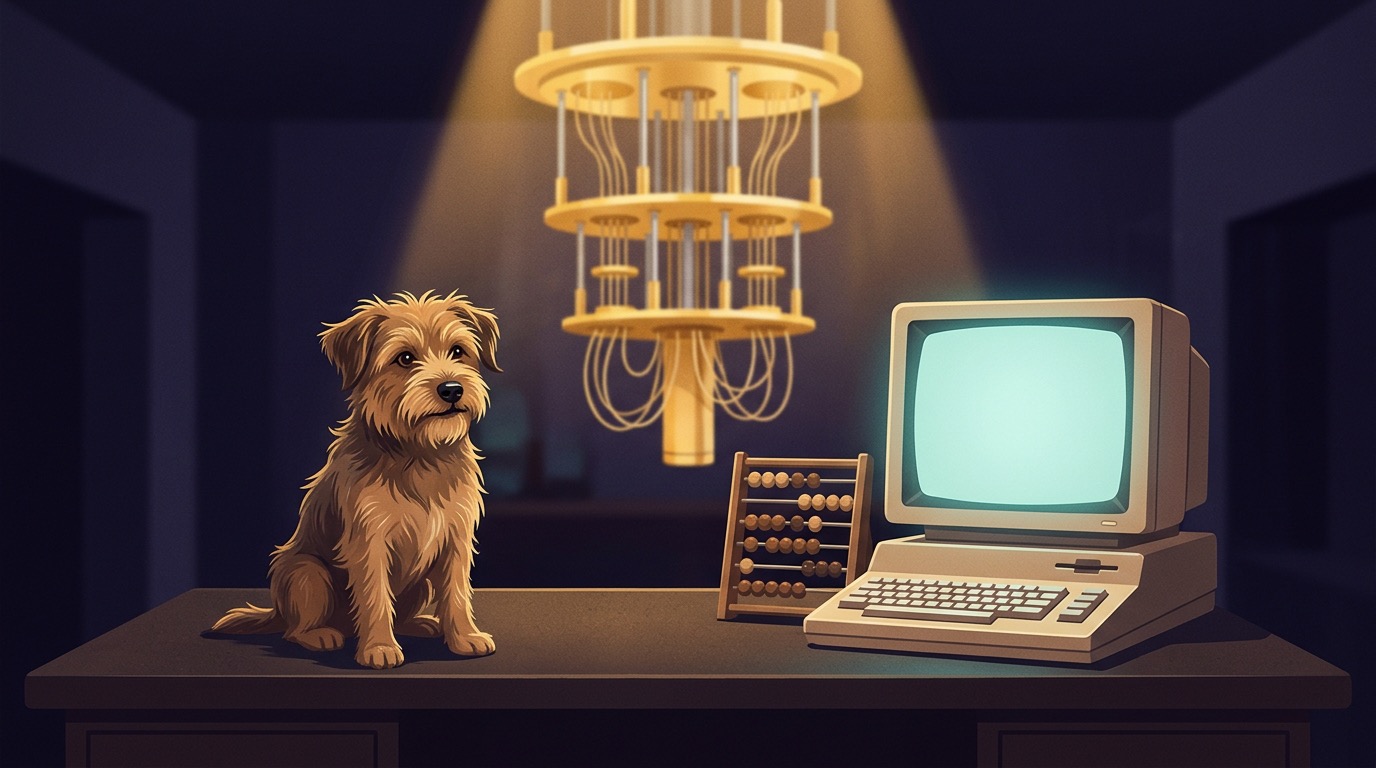
- In 2025 Peter Gutmann and Stephan Neuhaus matched every such record with a 1981 home computer, an abacus and a dog.
The honest record stays at 15: the 2001 nuclear-magnetic-resonance run, or the 2016 trapped-ion run if the first does not count as quantum. A search for this page found no honest run on 21 or above through November 2026.
2 · The gates today
Each extra nine has taken eight to ten years
A two-qubit gate with 99.9% fidelity fails once in a thousand uses. Trapped ions hold the records: 99.3% in 2008, 99.9% in 2016, 99.99% in 2025. Superconducting chips went from 99.4% in 2014 to 99.9% in 2023. Whole machines run years behind the best pair in a lab.
Two-qubit gate fidelity, best published results
Each step up the scale is ten times fewer errors. Tap a point for the source.
- Trapped ions
- Superconducting
- Neutral atoms
- Filled: average over a whole machine
- Hollow: best pair in a lab
Around 99%, error correction starts to help. 99.9% is what the code-breaking estimates assume on every gate.
The same data as a table
| Year | Platform | Fidelity | Scope | Source |
|---|
Platform by platform, November 2026
| Platform | Best pair in a lab | Whole machine | Trade-off |
|---|---|---|---|
| Trapped ions | 99.99% (Oxford Ionics, owned by IonQ, October 2025 preprint) | 99.921% over 98 qubits (Quantinuum Helios); 99.914% over 20 qubits in 2024 (company report) | Any qubit can reach any other. Each step takes about a thousand times longer than on a chip. |
| Superconducting | 99.92% (MIT fluxonium, 2023) | 99.67% over 105 qubits (Google Willow, 2024); 99.62% over 105 (USTC Zuchongzhi 3.0, 2025) | Fast: about a microsecond per error-correction cycle. Each qubit talks only to its neighbours. |
| Neutral atoms | 99.85%, or 99.94% when runs that lost an atom are set aside (April 2026 preprint) | About 99.5% in runs with hundreds of atoms (Harvard and QuEra) | The largest arrays: 6,100 atoms trapped at Caltech. Slow cycles, and atoms get lost. |
| Spin qubits in silicon | Above 99% on devices from a chip foundry (Diraq and imec, 2025); 99.5% in university devices | A dozen qubits at most | Made like ordinary chips. Still very small. |
| Photonics | No comparable gate figure: the published numbers are for components | Loss of photons is the main error. | |
| Topological (Microsoft) | No gate shown. Nature's editors noted that the 2025 paper is not evidence of the Majorana modes the design needs. | Would need far less error correction if it works. | |
What the largest circuits look like without error correction
IBM's newest chip runs circuits of "more than 7,500 quantum operations", and the next is designed for 10,000. These use error mitigation: many noisy runs are combined into a corrected average.
Mitigation recovers averages, not single answers. At 99.7% per gate, about 3 runs in 10 million get through 5,000 gates untouched. Shor's algorithm needs individual runs to come out right, so it needs real error correction.
3 · How good is good enough
Three nines to start, far more to finish
Error correction spreads one "logical" qubit across many physical ones and checks them constantly. It only helps once the physical gates are better than a threshold, about 99% for the most-studied code, the surface code. A code's size is called its distance: distance 3 uses 17 physical qubits, distance 7 about 100. Every recent estimate for breaking encryption assumes 99.9% on every gate of a very large machine.
What Scott Aaronson has said
"Fault-tolerant" means computing on error-corrected qubits from start to finish.
- Sep 2024
How good: "at least on paper", fault tolerance "becomes a net win" once two-qubit gates are "~99.99% reliable". (talk)
- Sep 2024
How fast: from the late 1990s, "the 50% became 90%, became 95%, became 99%, and within the past year, multiple groups have reported 99.9%."
- 13 Nov 2025
When: "a live possibility that we'll have a fault-tolerant quantum computer running Shor's algorithm before the next US presidential election." Factoring 15 that way would count, he added. (post)
- 21 Dec 2025
How good, restated: several platforms now have ">99.9% fidelity two-qubit gates, at or above the theoretical threshold for fault-tolerance." (post)
- 29 Apr 2026
When, for code-breaking: experts he trusts say a machine able to break deployed cryptography "ought to be possible by around 2029." Then: "I'm not a timing guy." (post)
- 7 Aug 2026
Status: "Scalable fault-tolerance is still in the future". (post)
A search of his blog for this page found no statement of how many years each nine takes, and no forecast of the form "another N years at current rates". The eight to ten years per nine comes from the published records in the chart above.
More of his dated statements
- 3 Feb 2012: offers "US$100,000" for a demonstration "that scalable quantum computing is impossible in the physical world". It is unclaimed. (post)
- 10 Dec 2024, on Google's Willow: gate fidelity "roughly 99.7% … compared to ~99.5% in 2019". "Please don't ask me to predict how long". Milestones arrive at intervals "measured in years". (post)
- 20 Nov 2025, a week after the election remark: "a 'live possibility' is short not only of a 'certainty,' but of a 'probability.'" (post)
- 21 Dec 2025: he now takes more seriously the companies' roadmaps for "2028 or 2029".
- 18 Feb 2026, in a comment on the estimate of 100,000 qubits for RSA-2048: "State-of-the-art systems right now have ~100 physical qubits, or a few hundred at most." (comment 30)
- 2 Apr 2026: "I can't give anyone reassurance that (say) a 3- or 4-year timeline from here to CRQC is out of the question". CRQC is a machine that breaks deployed cryptography. (comment)
- 7 Apr 2026, on factoring: "the actual goal is to factor using Shor's algorithm on a fault-tolerant QC. That has not yet been done."
How much hardware a logical qubit costs depends on one measured number, written : how many times the error falls each time the code grows by one step. Google measured in 2024. The code-breaking estimates assume gates ten times better than the threshold, which means near 10.
What one good logical qubit costs
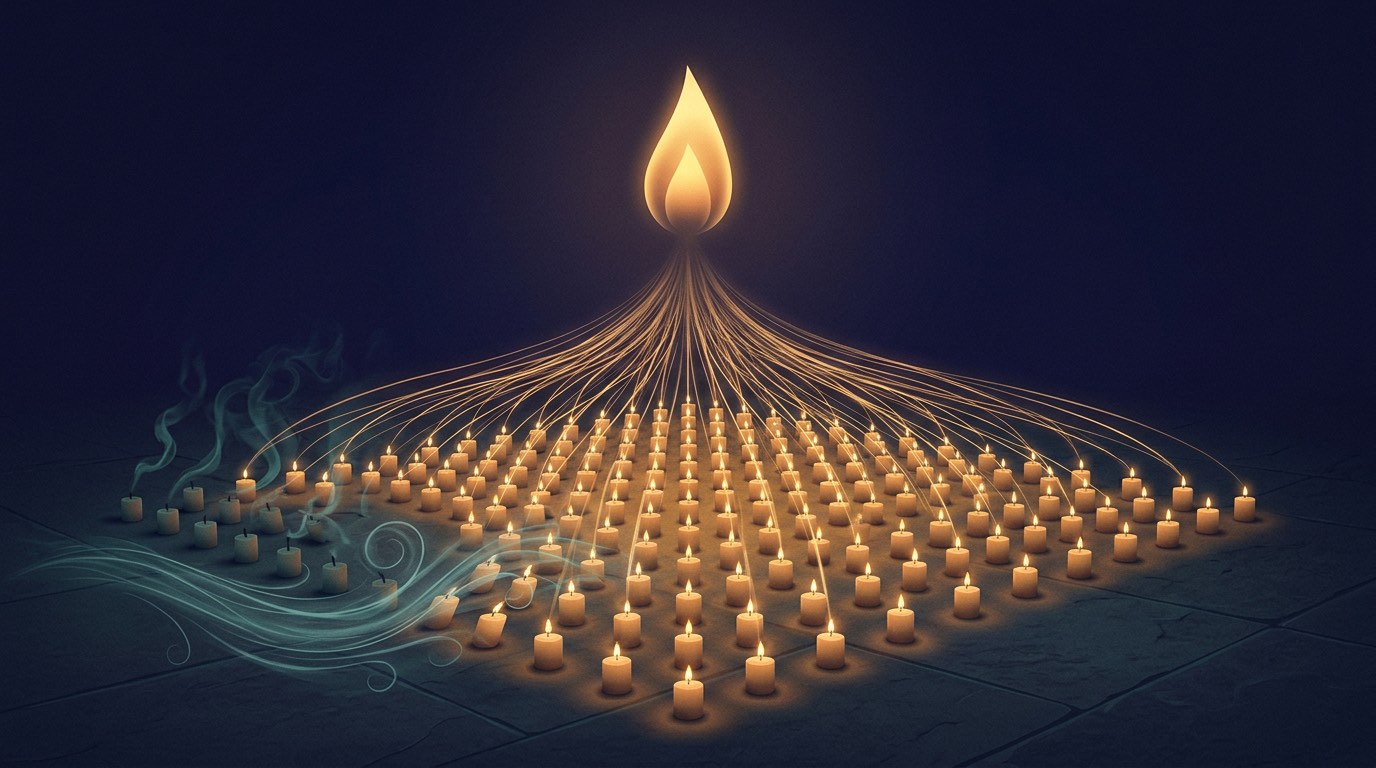
Each dot is a physical qubit holding data. All of them together hold one logical qubit.
A rule of thumb fitted to Google's 2024 measurement, not a design. At Λ = 2.14 it gives distance 27 and 1,457 qubits for one error in a million, the figure Google quotes. Real designs store idle qubits more densely, which is how the 2025 estimate stays under a million.
The rule of thumb, and what Λ has measured so far
For a surface code of distance , which uses physical qubits, the error per cycle falls as
where is the physical error rate and , about 1%, is the threshold. The constant 0.03 is chosen so that the formula passes through Google's distance-7 result.
| Experiment | Λ | What was measured |
|---|---|---|
| Google, 2023 | 1.04 | Distance 5 beat distance 3, barely: 2.914% against 3.028% per cycle. |
| Google Willow, 2024 | 2.14 | Distance 7 on 101 qubits: 0.143% per cycle. The logical qubit outlived the best physical one 2.4 times. |
| USTC Zuchongzhi 3.2, 2025 | 1.40 | Distance 7 on 107 qubits. |
| Quantinuum Helios, 2026 | not comparable | A different, small code on ions: 0.0046% memory error per cycle. The company reports a roughly twelvefold cut per step for another code; no paper was found for that. |
What a useful machine needs
| Machine or task | Logical qubits | Operations | Physical qubits |
|---|---|---|---|
| "Megaquop" machine (John Preskill's name for the first useful step) | about 100 | 1 million | Not specified |
| IBM Starling, planned for 2029 | 200 | 100 million | IBM says its codes need about a tenth of the surface code's |
| Break 256-bit elliptic-curve keys (Google and others, March 2026) | under 1,200 | under 90 million Toffoli | Under 500,000 |
| Factor RSA-2048 (Gidney, May 2025) | about 1,400 | about 6.5 billion Toffoli | Under 1 million |
| Factor 21 (Gidney's circuit, August 2025) | 15 | 369 Toffoli | No estimate published |
Cheaper codes exist on paper. IBM's "gross" code holds 12 logical qubits in 288 physical ones, where the surface code would need about 3,000. It needs long-range wiring between qubits, which IBM first put on a test chip in 2025.
4 · The skeptic
Gil Kalai's predictions, and what the machines did

Gil Kalai, a mathematician at the Hebrew University of Jerusalem, has argued for twenty years that quantum computers cannot work at scale. His main argument is about noise: a noisy machine, he says, can only produce outputs simple enough for an ordinary computer to imitate, so it can never reach the quality that error correction needs. A second strand says errors on entangled qubits arrive together, in bursts that defeat error correction.
In 2019 he wrote down predictions that "will be tested in the next few years". They were.
Small error-correcting codes will fail
- He predicted
- Attempts to build distance-5 surface codes "will fail, and the difficulties will be evident already in the baby goals", such as distance 3.
- What happened
- Google's distance 5 beat distance 3 in 2023. In 2024 distance 7 beat both, with the error halving at each step. A Chinese team repeated distance 7 in 2025.
- He says now
- "The quantum error correcting codes, they are not strong enough so far to refute my theory" (August 2026). In March 2026 he asked to discuss the 2024 data with Google's team.
Gate quality will stall
- He predicted
- "The quality of qubits and gates cannot be improved beyond a certain threshold that is quite close to the best currently existing qubits and gates."
- What happened
- The best pair went from 99.9% to 99.99%. The best whole machine went from 99.4% on 53 qubits to 99.92% on 98.
- He says now
- Efforts to cut gate errors "will hit a wall" (August 2026).
No quantum computer will beat classical ones at sampling
- He predicted
- Random-circuit "supremacy" with 50 to 100 qubits will fail.
- What happened
- Google claimed it on 53 qubits in 2019, and classical computers caught up with that run in 2024. Later runs, on cleaner and larger machines, have not been matched in print.
- He says now
- His audit of the 2019 data found it "may indeed have been flawed". He grants that the experiment, "if it stands, directly refutes my conjecture".
Errors come correlated
- He predicted
- "Every pair of gated qubits will be subject to errors with large positive correlation", leading to bursts. He called this secondary: the main argument "does not depend on" it.
- What happened
- Errors fell exponentially as codes grew, which heavy correlation would prevent. What is left is a floor of rare bursts, about one an hour on Google's chip.
- He says now
- The correlated-noise conjectures "remain undecided after twenty years" (March 2026).
Bigger codes now beat smaller ones, down to a floor set by rare bursts
Logical error per cycle against code size. The line is a simple model: set how much each step helps, and how often a burst wipes out the whole code.
- Model
- Google, 2023
- Google Willow, 2024
- Willow, simpler repetition code
- Quantinuum ions, 2026 (a different code)
Measured points: Google 2023, 3.028% and 2.914% at distances 3 and 5. Willow 2024, 0.143% at distance 7; its distance 3 and 5 points are worked back from the published Λ. Willow's repetition code bottoms out near one error in 10 billion cycles at distance 29. Quantinuum's small code on ions: 0.0046% per cycle (preprint).
So are errors independent enough? For one logical qubit held in memory on about 100 physical qubits, yes. For hundreds of logical qubits computing for days, nobody has measured it. Aaronson's verdict in 2026 is that Kalai is "fighting a losing battle at this point". Kalai calls his own case "a good argument for why quantum computers cannot work, but this is not an ironclad argument".
His argument in a little more detail
- Noisy machines are weak. His central assertion: what today's noisy devices can robustly produce "can be described by low-degree polynomials", a class of computation far inside what ordinary computers do. The idea comes from his 2014 work with Guy Kindler on noisy systems of photons.
- Error correction is harder than supremacy. "Achieving quantum supremacy is easier than achieving quantum error-correction." If the first is out of reach, so is the second.
- The weak link, in his own words. The step from that asymptotic statement to machines of a fixed small size "can be regarded as both a novel and a weak link of our argument".
- A guess he attached. The effort to control qubits well grows exponentially and fails early: "My guess is that the number will be ≤ 20."
His audit of Google's 2019 experiment
With the statisticians Yosef Rinott and Tomer Shoham, and later Carsten Voelkmann, Kalai has re-analysed the data from Google's 2019 run: one paper in Statistical Science (2022) and preprints in 2022, 2023, 2024 and December 2025, the last using more detailed data that Google supplied.
- They say the match between Google's predicted and measured fidelity is "statistically implausible", and they question how the chip was calibrated.
- They point out that the classical running time was off by ten orders of magnitude, which later simulations bear out.
- No formal reply from Google was found. Aaronson's answer: the 2019 experiment "was long ago superseded anyway".
In March 2026 Kalai wrote that "we would love to have a similar discussion with the relevant Google team about the 2024 distance-3,-5,-7 surface code paper", and that the exponential decay of accuracy, "if confirmed, is overall encouraging".
The replies, and the other skeptics
- Aram Harrow, 2012, in a written debate with Kalai: if errors were correlated that strongly, ordinary computers would fail the same way, because every memory cell is a small error-correcting code.
- Scott Aaronson, 2012: the $100,000 offer above. In 2025: "Evidence continues to pile up that we are not living in the universe of Gil Kalai and the other quantum computing skeptics."
- What Kalai concedes: "I don't take it as axiomatic that scalable quantum computing is impossible" (December 2024), and "My goal is to advance understanding—even if the conclusions eventually go against my own views" (March 2026).
- Mikhail Dyakonov, a physicist, argues that controlling the continuous parameters of thousands of qubits is hopeless in practice ("When will we have a quantum computer?", 2019). His argument is about engineering, and makes no dated prediction.
5 · Early announcements
Twenty years of early announcements
The pattern is steady. Hardware milestones, such as more qubits, better gates and working error correction, have mostly arrived when promised. Claims of a speedup or a use have mostly been matched by ordinary computers soon after.
What was claimed, and what happened
- 2001Did not scale
IBM and Stanford factor 15 in a test tube of molecules.
Such molecules carry no entanglement, as a 1999 proof showed, and the method stopped at about a dozen qubits.
- 2007Never substantiated
D-Wave shows a 16-qubit "commercial quantum computer" solving a Sudoku.
Nothing showed it used quantum effects. Aaronson: "either substantially fake or entirely fake".
- 2008 to 2009No speedup
Hartmut Neven of Google, with D-Wave: image recognition and a car detector "with the quantum adiabatic algorithm".
The 2008 papers ran on ordinary solvers. The 2009 detector was trained on a D-Wave chip. No speedup was ever shown.
- 2013Overtaken
Google and NASA buy a D-Wave Two, reported as 3,600 times faster than standard software.
Tuned code on a laptop kept pace. A 2014 study in Science found no speedup.
- 2015Overtaken
Google: its D-Wave is 100 million times faster than the standard method on one processor core.
On problems built to suit it. Other classical methods kept up.
- 2015Half open
Michele Mosca, a cryptographer: a one-in-seven chance that RSA-2048 falls by 2026, one in two by 2031.
Not broken in 2026.
- 2018Retracted
A Microsoft-backed team reports Majorana particles, the basis of its qubit, in Nature.
Retracted in 2021. Its 2025 chip claim was formally challenged in 2026.
- 2018 to 2020Missed
Rigetti: 128 qubits "within 12 months". PsiQuantum: a million qubits by about 2025.
Neither arrived. PsiQuantum now aims at 2027 to 2029.
- 2019Overtaken
Google: 200 seconds on its Sycamore chip against 10,000 years on a supercomputer.
IBM estimated, without running it, that 2.5 days would do. In 2024 it was done classically in 86 seconds.
- 2023Overtaken
IBM: a 127-qubit run shows quantum "utility".
Simulated within two weeks, once on a laptop.
- 2023Kept
IBM ships the 1,121-qubit chip its 2020 roadmap promised.
On time.
- 2024Kept
Google: error correction "below threshold", the second milestone on its roadmap.
Published in Nature and repeated in China in 2025.
- Jan 2025Withdrawn
Jensen Huang of Nvidia: "very useful" quantum computers are 15 to 30 years off.
Quantum stocks fell about 40% in a day. He took it back two months later.
- Feb 2025Open
Hartmut Neven: "real-world applications that are possible only on quantum computers" within five years.
Open until early 2030.
- 2025Disputed
D-Wave, in Science: a simulation worth nearly a million supercomputer years.
Partly matched classically in 2026. D-Wave says the result stands.
- 2025Standing
Google "Quantum Echoes": 13,000 times faster than a supercomputer, and checkable.
Not matched so far.
- 2025Kept
Quantinuum ships Helios on schedule, with the best gates of any full machine.
The 10,000-year task now takes a classical computer 86 seconds
How long each task was said to take an ordinary supercomputer, and how long it has taken since.
- Classical time claimed at the announcement
- Classical time achieved since
A claim that a task is beyond ordinary computers is a claim about algorithms nobody has written yet. Three of these four still stand.
Hartmut Neven's adiabatic years, 2007 to 2015
- 2008: "Image recognition with an adiabatic quantum computer", with D-Wave's founders, recasts image matching as an optimisation problem of the kind D-Wave's machine was built for. It is a recipe, not a measurement.
- November 2008: "Training a binary classifier with the quantum adiabatic algorithm". The training was done by ordinary heuristic solvers; the paper expects "additional gains" from "the actual quantum processor".
- December 2009: a Google research post reports a car detector trained on a D-Wave chip, and says it "performs better than those we had trained using classical solvers". No speedup was measured, and the companion paper rests on simulation.
- 2013 to 2015: the D-Wave Two purchase and the two speed claims in the list above.
- From 2014 Google built its own gate-based chips under John Martinis. Those produced the 2019 and 2024 results.
- 2019: "Neven's law", his claim that quantum computing power grows doubly exponentially.
The adiabatic work never showed an advantage. Neven's lab later delivered two of the field's real milestones.
Why "supremacy" became "advantage" and then "utility"
John Preskill coined "quantum supremacy" in 2012 for the first task a quantum machine does that no ordinary computer can. After Google's 2019 paper some researchers objected to the word's overtones, and "quantum advantage" took over. IBM introduced "utility" in 2023 for results that are hard to simulate exactly but claim no proof.
Each change also loosened the claim. "Supremacy" can be refuted by one classical simulation, as in 2024. "Advantage" and "utility" have no agreed test.
6 · Projections
The estimates fell a thousandfold. The machines have about 100 qubits.
The estimated machine for breaking 2,048-bit RSA shrank from about a billion qubits in 2012 to 20 million in 2019 and under a million in 2025. Three papers in 2026 put it between 10,000 and 100,000, each with a newer code or a different kind of hardware. None of this is hardware progress: it is better algorithms, on paper.
Qubits needed to break RSA-2048, and qubits built
Every step down the scale is ten times fewer qubits. Tap a point for the source.
- Estimate, standard code on a chip
- 2026 estimate, newer codes or other hardware
- Machine built
- Company target
The same data as a table
| Year | What | Qubits | Note |
|---|
Who says when
Round marks are forecasts, diamonds are company targets, squares are official deadlines.
Kalai's forecast is "never". Jensen Huang's withdrawn one, 2040 to 2055, is off the scale.
The sharpest change in 2026 was for the elliptic-curve keys that protect Bitcoin and most web traffic. In March a Google paper with Dan Boneh and Justin Drake put breaking a 256-bit key at under 500,000 qubits and a run of minutes. Google has set itself 2029 to finish replacing such keys. Replacements exist and are standardised, so this application has a known defence.
This year's estimates, side by side
| Paper | Target | Physical qubits | Run time | Rests on |
|---|---|---|---|---|
| Gidney, May 2025 | RSA-2048 | under 1 million | under a week | 99.9% gates, microsecond cycles, a plain grid |
| Iceberg Quantum, Feb 2026 | RSA-2048 | under 100,000 | about a month, as reported | Denser codes that need long-range links between qubits |
| Google and others, Mar 2026 | 256-bit elliptic curve | under 500,000 | minutes | 99.9% gates on a plain grid. The circuits are withheld; a proof that they exist is published. |
| A Caltech-led team, Mar 2026 | 256-bit elliptic curve | as few as 10,000 atoms | "a few days" with 26,000 atoms; RSA-2048 ten to a hundred times longer | Neutral atoms that can be moved around, with high-rate codes |
| IonQ, Sep 2026 | 256-bit elliptic curve | 19,397 ions | about 26 days a try | Company blueprint; slow ion cycles |
| Alice & Bob, Oct 2026 | RSA-2048 | 22,593 cat qubits | 3.14 days | Company paper; a special qubit that suppresses one kind of error |
The headline reading, that the job keeps getting ten times easier, hides the catch: each cut assumes hardware nobody has built, such as long-range links, 99.9% gates across 100,000 qubits, or month-long stable runs. Gidney is reported to see no further tenfold cut in his own design without changing its assumptions.
Company roadmaps, and what arrived in 2026
| Who | Target | Status, November 2026 |
|---|---|---|
| IBM | Starling in 2029: 200 logical qubits, 100 million gates. Blue Jay in 2033: 2,000 logical qubits. | The 2026 chip that was to combine memory and logic, Kookaburra, was not shown at IBM's November conference. Starling was reconfirmed. |
| Quantinuum | Sol in 2027: about 100 logical qubits. Apollo in 2029: full fault tolerance. | Helios delivered in 2025. The company says Sol is on track. |
| IonQ | 10,000 qubits in 2027; 2 million qubits and 40,000 to 80,000 logical qubits in 2030. | No report was found that its 256-qubit step for 2026 has arrived. |
| Six milestones ending at a million qubits. No dates. | Two reached. The third, a logical qubit good to one error in a million, is not yet claimed. | |
| PsiQuantum | About a million photonic qubits, in Brisbane and Chicago. | Targets around 2027 to 2029. |
| DARPA | Judge whether anyone can build a "utility-scale" machine by 2033. | Six companies in the final stage: Microsoft and PsiQuantum from an earlier pilot, and Atom Computing, Diraq, IBM and IonQ since October 2026. |
The programme's managing director, Micah Stoutimore, in October 2026: "we increasingly expect that someone will build a utility-scale quantum computer by 2033."
Why a slow machine must be a big machine
Gidney's week for RSA-2048 assumes an error-correction cycle of a millionth of a second, which superconducting chips manage. Ions and neutral atoms take about a thousandth of a second. This page's arithmetic: the same design at that speed would run for about 19 years.
The estimates for atoms and ions get round this by doing far more in parallel or by using denser codes, which is why their run times are days to weeks for the easier elliptic-curve problem.
7 · What it is for
Two proven uses, and a narrow door for data
After thirty years, two uses have solid theory behind them: breaking today's public-key cryptography, and simulating quantum physics and chemistry. Aaronson's list in December 2025 is the same two, plus "some modest benefits for optimization, machine learning, and other areas", "eventually".
A quantum computer takes its input through its control lines, one precise pulse at a time. There is no fast way to pour a large dataset in. The strong candidates are problems with a tiny input and an enormous calculation, which describes code-breaking and chemistry and rules out most data-heavy work.
Chemistry: what the fertiliser example needs
The standard example is the molecule at the heart of the enzyme that lets bacteria fix nitrogen at room temperature, where industry uses the hot, high-pressure Haber-Bosch process. Simulating it was estimated in 2021 to need about 4 million physical qubits for under four days.
Two cautions are widely voiced. A simulation would explain how the enzyme works; it would not by itself give a better catalyst. And most of the energy in Haber-Bosch goes into making hydrogen, which no catalyst for the nitrogen step removes. A 2023 study also found the evidence for an exponential quantum advantage in such chemistry unproven.
Why search-type speedups probably do not pay
Many proposed uses in optimisation and machine learning rest on a square-root speedup: a million steps instead of a trillion. Error correction makes each quantum step thousands to millions of times slower than a transistor's. A 2021 analysis from Google concluded that such speedups will not beat ordinary computers on early fault-tolerant machines.
The data-loading problem
- Aaronson's 2015 essay "Read the fine print": the famous exponential speedups for linear algebra and machine learning assume the data is already loaded into a quantum state and that one number at the end is all you want.
- In 2018 Ewin Tang, then an undergraduate, showed that for recommendation systems an ordinary algorithm does about as well given the same access to the data.
- A 2023 survey of quantum memory found that a fault-tolerant version costs so much that it erases the advantage for big-data uses.
The ordinary computer beside it
Every error-correction cycle produces measurements that an ordinary computer must decode before the next step can depend on them. Google's 2024 experiment decoded in real time with an average delay of 63 microseconds; the code-breaking estimates assume 10. IBM, Nvidia and AMD are all building decoder hardware for this. A large quantum computer is also a large classical one.
Where this leaves it
- The obstacle the skeptics predicted has not appeared at the scale tested: about 100 qubits and one or two logical qubits.
- What is left is scale. About 100 good qubits exist; the estimates need 10,000 to a million. No machine has run even the few hundred error-corrected Toffoli gates that 21 needs.
- The milestone to watch is the first fault-tolerant run of Shor's algorithm on any number, 15 included. An honest 21 comes after that.
- Treat the dates with the record in mind. Roadmaps and optimists say 2028 to 2033. Dated hardware milestones have mostly been kept. Dated claims of usefulness mostly have not.
Sources
Read for this page on 16 November 2026. Preprints and company statements are marked in the text; they have not been through peer review. Figures marked as this page's arithmetic are its own.
All sources, by section
Factoring
- Craig Gidney, "Why haven't quantum computers factored 21 yet?", 30 August 2025, and its circuit file
- Vandersypen et al., factoring 15 by nuclear magnetic resonance, Nature 2001
- Monz et al., a scalable Shor algorithm on trapped ions, Science 2016
- Smolin, Smith and Vargo, "Oversimplifying quantum factoring", Nature 2013
- Gutmann and Neuhaus, "Replication of Quantum Factorisation Records with an 8-bit Home Computer, an Abacus, and a Dog", 2025
- Berthusen et al., a compact fault-tolerant architecture on Quantinuum Helios, preprint, 2 September 2026
- IBM and the University of Chicago, logical circuits, company release, 30 July 2026; preprint
Gates and error correction
- Google Quantum AI, "Quantum error correction below the surface code threshold", Nature 2025
- Google Quantum AI, "Suppressing quantum errors by scaling a surface code logical qubit", Nature 2023
- Quantinuum, the Helios processor, Nature 2026
- Oxford Ionics, a two-qubit gate at 99.99%, preprint, October 2025
- USTC Zuchongzhi 3.2 below threshold, news report of a December 2025 paper
- Neutral-atom gates at 99.85%, preprint, April 2026
- Earlier records: Leibfried 2003, Benhelm 2008, Barends 2014, Ballance 2016, Arute 2019, Levine 2019, Ding 2023, Evered 2023, Oxford Ionics 2024
- IBM developer conference blog, 11 November 2026
Scott Aaronson
- "Quantum Computing: Between Hope and Hype", 22 September 2024
- "The Google Willow thing", 10 December 2024
- "Quantum computing: too much to handle!", 13 November 2025
- "Quantum Investment Bros: Have you no shame?", 20 November 2025
- "More on whether useful quantum computing is 'imminent'", 21 December 2025
- "On reducing the cost of breaking RSA-2048 to 100,000 physical qubits", 15 February 2026
- "Quantum computing bombshells that are not April Fools", 1 April 2026
- "Will you heed my warnings NOW?", 29 April 2026
- "Enough with all the world-historic milestones", 7 August 2026
- The $100,000 offer, 3 February 2012
Gil Kalai
- "The Argument against Quantum Computers", 2019
- "Scott Aaronson's View of my View About Quantum Computing", 10 March 2026
- Interview with Yuval Boger, 1 August 2026
- "The Case Against Google's Claims of Quantum Supremacy", 9 December 2024
- Kalai, Shoham and Voelkmann, "Further Statistical Study of NISQ Experiments", preprint, December 2025
- The 2012 debate with Aram Harrow
Early announcements
- Aaronson on D-Wave's 2007 demonstration; on Google's 2009 post; on the 2013 speed claim
- Report of Google's December 2009 post
- The 2019 Sycamore task in 86 seconds on 1,432 GPUs, National Science Review 2024
- IBM's 2023 experiment simulated: Tindall et al., Begušić and Chan
- D-Wave's May 2026 statement
- Jensen Huang's January 2025 remark
- Hartmut Neven's February 2025 forecast
- Science on the Majorana dispute
Projections
- Google, "Tracking the cost of quantum factoring", 23 May 2025
- DARPA, four more teams enter the final stage, 7 October 2026
- Global Risk Institute, Quantum Threat Timeline Report 2025
- NIST IR 8547, the transition to post-quantum cryptography
- The Quantum Insider on the 2026 estimates, 31 March 2026
- IonQ roadmap; Quantinuum second-quarter 2026 results